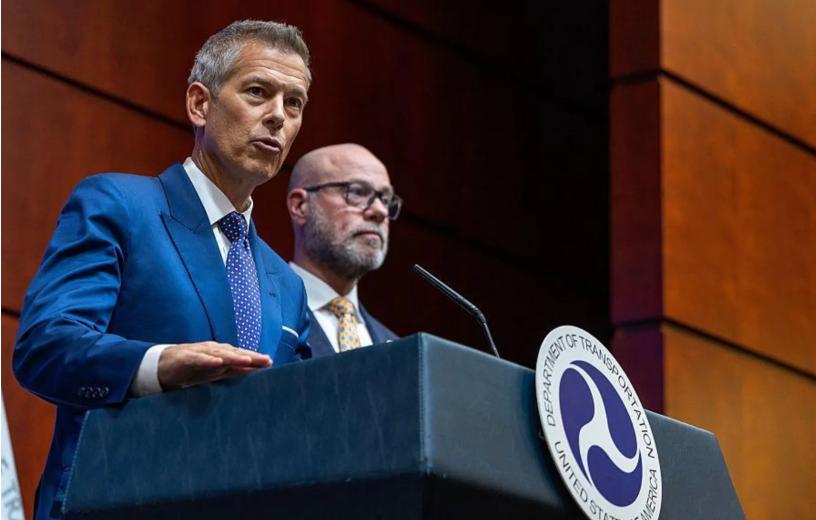
Transportation Secretary Sean Duffy has warned that air travel across the United States could face major disruptions beginning Friday morning, with a 10 percent cut in flight operations at 40 of the nation’s busiest airports if the ongoing government shutdown is not resolved.
Duffy said the move is intended to maintain safety and order in the skies as air traffic controllers, who have been working without pay for weeks, continue to report exhaustion and financial stress.
“It is unusual, just as the shutdown is unusual, just as the fact that our controllers haven't been paid for a month is unusual,” said Bryan Bedford, head of the Federal Aviation Administration (FAA), during a briefing with Duffy on Wednesday.
According to Bedford, the cutbacks will be phased in gradually, starting with 4 percent of domestic flights being grounded on Friday, 5 percent on Saturday, and 6 percent on Sunday—before reaching the full 10 percent next week. The FAA said the list of affected airports, all major high-traffic hubs, will be released on Thursday.
Officials estimate that between 3,500 and 4,000 flights could be canceled each day once the full reduction is in place. Bedford said the measure is necessary to prevent the situation from spiraling into a safety crisis.
“We are seeing pressures build in a way that we don't feel—if we allow it to go unchecked—will allow us to continue to tell the public that we operate the safest airline system in the world,” Bedford said.
Duffy added that while air travel remains safe for now, the situation has become increasingly difficult to manage. “The decision to cancel flights is being made to ensure safety and efficiency,” he said, warning that if the shutdown persists, further restrictions could follow.
The shutdown, now the longest in US history, began on October 1 when government funding lapsed. While most federal employees were sent home and promised pay once operations resume, essential workers like air traffic controllers have been forced to continue working without pay.
Airports have already begun to feel the strain. Some have had to halt operations for several hours when too many controllers called in sick, while others have relied on staff flown in from different locations to stay open.
Nick Daniels, president of the labor union representing more than 20,000 aviation workers, described the situation as dire. “Air traffic controllers are texting ‘I don’t even have enough money to put gas in my car to come to work,’” he told CNN. “We base what we do day in and day out on predictability. Right now, there is no predictability.”
Airlines have also begun responding to the looming disruptions. American Airlines said it is awaiting FAA guidance to determine which flights will be affected, but expects most customers’ travel to continue as planned.
Southwest Airlines said it is still assessing the impact of the restrictions and will update travelers as soon as possible. “We continue to urge Congress to immediately resolve its impasse and restore the National Airspace System to its full capacity,” the airline said in a statement. Delta Airlines declined to comment.
Duffy earlier cautioned that half of the country’s 30 major airports are already struggling with staff shortages, and warned of the dangers of controllers taking on second jobs to make ends meet.
“They have to make a decision—do I go to work and not get a paycheck and not put food on the table? Or do I drive for Uber or DoorDash or wait tables?” he said.































Comments
Sign in with Google to comment, reply, and like comments.
Continue with Google